 operationalportal.com
DECEMBER 5, 2017 |
 THE WORLD OF CHINESE
The light of the low-hanging morning sun comes rushing through the windows. There aren’t any curtains in the viewing room, and the lights are all on, but no one complains because, in spite of the brightness, the room and the world remains in darkness for most of the audience at Beijing Hongdandan Visual Impairment Cultural Service Center’s Mental View Movie Theater. The stand next to the door has one umbrella, and the rest is taken up with red and white, lollipop-like canes.
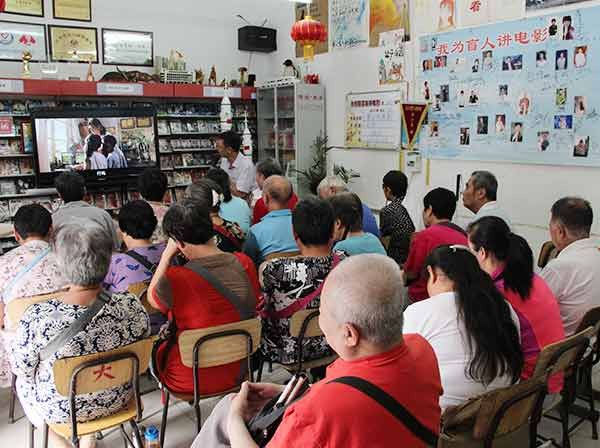 Mental View Movie Theater (心目影院) plays movies for the blind in Beijing. (ricedonate.com)
If I didn’t know where I was, I would assume that the audience was bored by the film. Many have their heads down, and their eyes are closed. One man with hair as gray as his coat is crouched over in his seat, head in hands, elbows on knees. He looks as if he is praying, but I know that he isn’t. He is out for a day at the movies.
In some ways, the scene takes me back in time. It as if we are all in the 1940’s, gathered around an old Philco radio except that where we are gathered looks neither like a theater nor like a living room. The colorful decorations: photos, posters, hand-drawn pictures and paintings, the pushpins put into the panels on the wall make it feel as if we are in an elementary school. The elderly audience is arranged in rows, sitting on wooden, schoolchildren chairs.
In spite of the greater attention to sound in this theater, it is just as loud as any cinema for the sighted. There are the badly muffled scuffles of footsteps and scooting chairs as folks file in late. Phones go off; whispers rise up; bags are opened and shifted around. There isn’t a concession stand, so no crunching nuts or chewing popcorn stifle the silence, but there is free tea on the table, and the man in the black bowler hat stirs up a dry-leaves-in-fire-like crinkling sound as he reaches into a plastic, takeaway bag for his bottle. A woman fiddling around with the collapsed parts of her cane makes a loud clack, clack like horses’ hooves.
 Though elderly, they look like schoolchildren seated in rows at the theater. (photos.caijing.com.cn)
I stop my writing for a while and try just to listen, eyes closed. It’s funny because today’s narrator, a middle-aged woman on a chair with a microphone explaining all of the parts of the film that the blind cannot see, doesn’t just tell us what’s happening, unconsciously perhaps, she is narrating her own experience of this story. We hear her “哇” when she expresses surprise, the quick huffs of her breath when she thinks something is funny; she asks questions about the things that confuse her.
I am starting to get it. I feel it. The images are not irrelevant, but they give me a different experience of this story than I have sitting here head down, staring into my lap. I feel more connected to the film. It’s more personal. I am not just peering into the lives of these characters but looking at them by listening through our narrator, our storyteller.
 Wang Weili, the founder of Mental View Movie Theater, narrates a film. (news.ifeng.com)
Some of the details she says are strange. ‘What,’ I wonder ‘does a red dress look like to those in the audience who were born blind?’
Interpreting the significance of the scenes and sounds, her narration reminds me of the government film lectures out in the Chinese countryside during Maoist times except that our “film lecturer” acknowledges her subjectivity.
“She wears the particular smile of a 22-year old woman,” our narrator describes. “It’s beautiful. I think that this is the most beautiful scene between people.”
As I listen, I realize that, for me, it is impossible to feel this film with my mental eye. If I can take any part in this theater tradition, it is as a narrator for those, like you, who are reading this description. This theater is my film, and you readers are my sightless audience, taken to this site through my words.
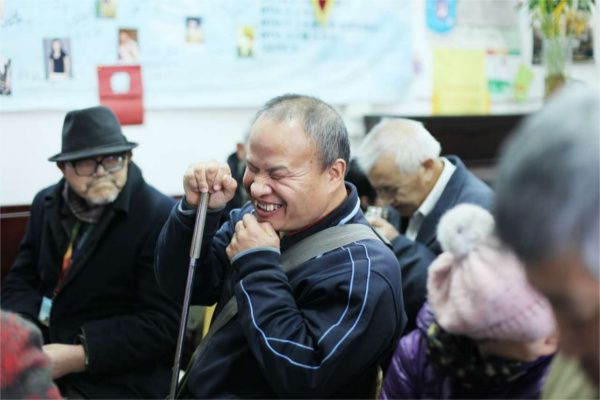 The visually-impaired in the audience see the films through their mental eye. (news.ifeng.com)
The narrator reads out the first few credits as the audience claps. “I hope everyone finds courage through this film,” she concludes. “I think that the most important feeling that this film gives us is that to love yourself is to love the world.”
For only a moment, all sounds are suspended in silence before people start milling about and making other plans.
“Are there any more activities today?” someone asks.
“Have you eaten yet?” asks someone else.
“Are you leaving? Where are you going?” ask the volunteers, helping everyone to make their exit.
It’s clear that folks have come for more than just the film. This is a social affair.
People stand together in groups outside. An old man hunched over a cane approaches me and says “hello.”
“Hello,” I reply.
“Are you an exchange student?” he asks.
“I am,” I say.
The narrator leaves with her friends.
“See you next time!” the same friendly old man calls out to her.
The bulk of the crowd has dwindled down to just a few not yet on their way to home or food. I am standing alone with my notebook in my hand. The old man stumbles past me with his cane. It is also time for me to make my departure.
 Many groups come only to see the theater, not the film. (bjyouth.gov.cn)
As I am about to make my way to the subway, a volunteer sees me on the street. He stops me, and he asks “what is it exactly that you’re doing here?”
As we speak next to the bus stop that he’s led the old man to, helping him to get onto the Number Five bus back home, Xiaojie Zheng, the organizer of Beijing Hongdandan, appears from out of the gate of the center’s small courtyard.
The volunteer calls her over to talk.
I ask Zheng if the new technology that allows visually-impaired people to hear audio-descriptions in theaters and through apps will affect the success of their theater.
“It won’t,” she says. “Coming here to listen to movies is a medium. Listening to movies [here]… [Visually-impaired individuals] can get a lot of people’s respect and acknowledgement… Our Mental View Movie Theater is a platform for blind people to integrate into society… Blind friends need to communicate with people. They don’t need to communicate with technology.”